The $220K Shadow on Every "Wait Until 70" Recommendation
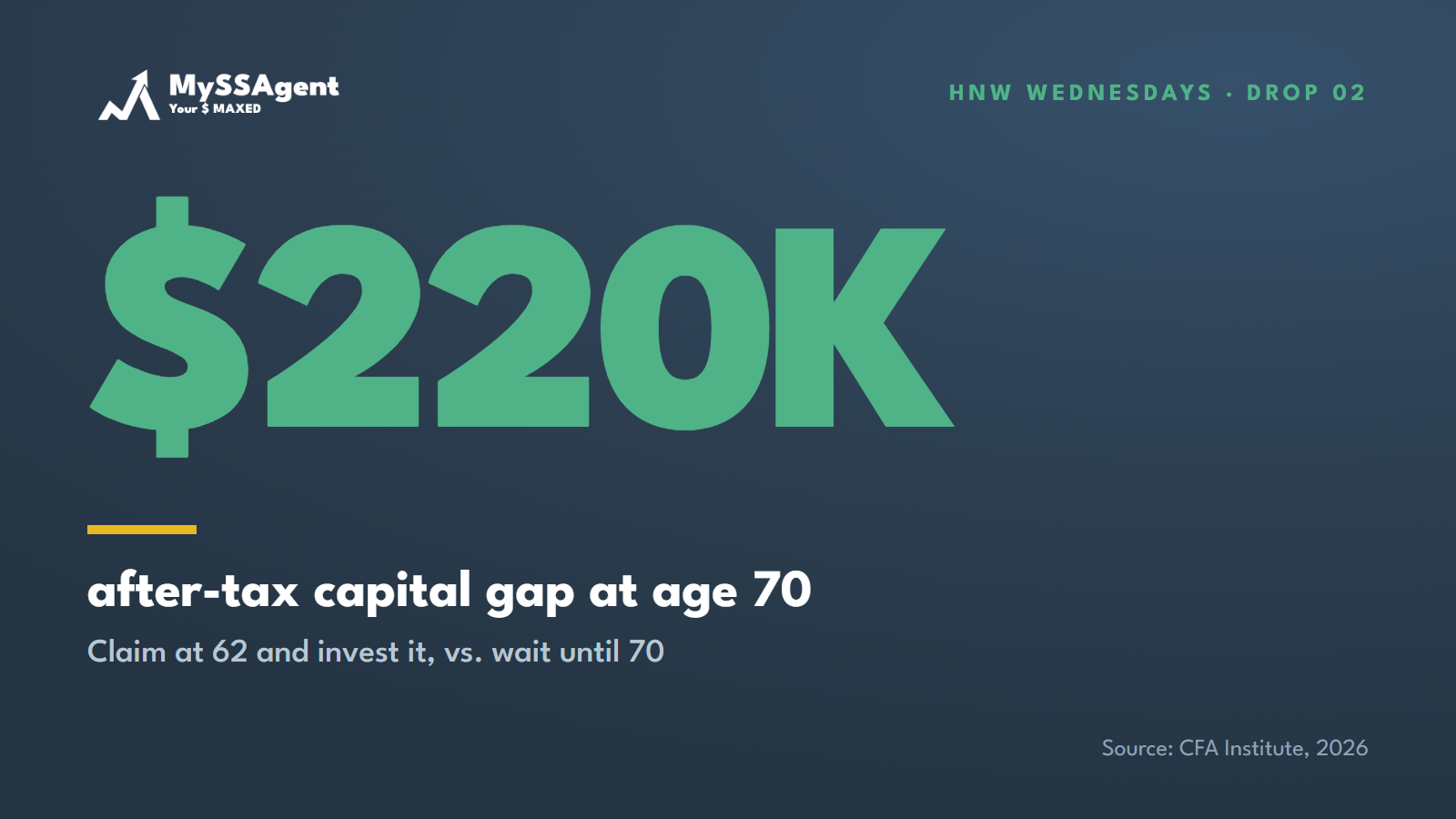
Most advisors carry a number in their head. The number is 70.
Wait until 70. Get the bigger check. Tell that to enough clients enough times and it stops feeling like advice and starts feeling like math.
It isn't.
For high-net-worth households (HNW), "wait until 70" carries a number on the back of it that nobody puts on the slide. That number is roughly $220,000 — the after-tax capital advantage the affluent claimer who takes Social Security at 62 holds over the affluent claimer who waits, by the time both of them turn 70.
That is not a rounding error. That is the shadow on every default delay recommendation that hasn't priced the opportunity cost of capital.
Where the number comes from
The CFA Institute ran the comparison in 2026, modeled for an affluent retiree who does not need the early Social Security check to cover living expenses. Two paths. Same client.
Path A — Default delay. Skip the early benefit. Wait until 70. Collect the larger monthly check for life. From 62 to 70: zero Social Security income.
Path B — Claim at 62, invest the proceeds. Take the reduced benefit (about 30% smaller than the full retirement age amount). Run it through a conservative portfolio. Pay taxes. Reinvest what's left.
By age 70, Path B is sitting on roughly $220,000 in additional after-tax capital that Path A does not have. The early claimer's monthly check is permanently smaller. The early claimer's household balance sheet is permanently larger.
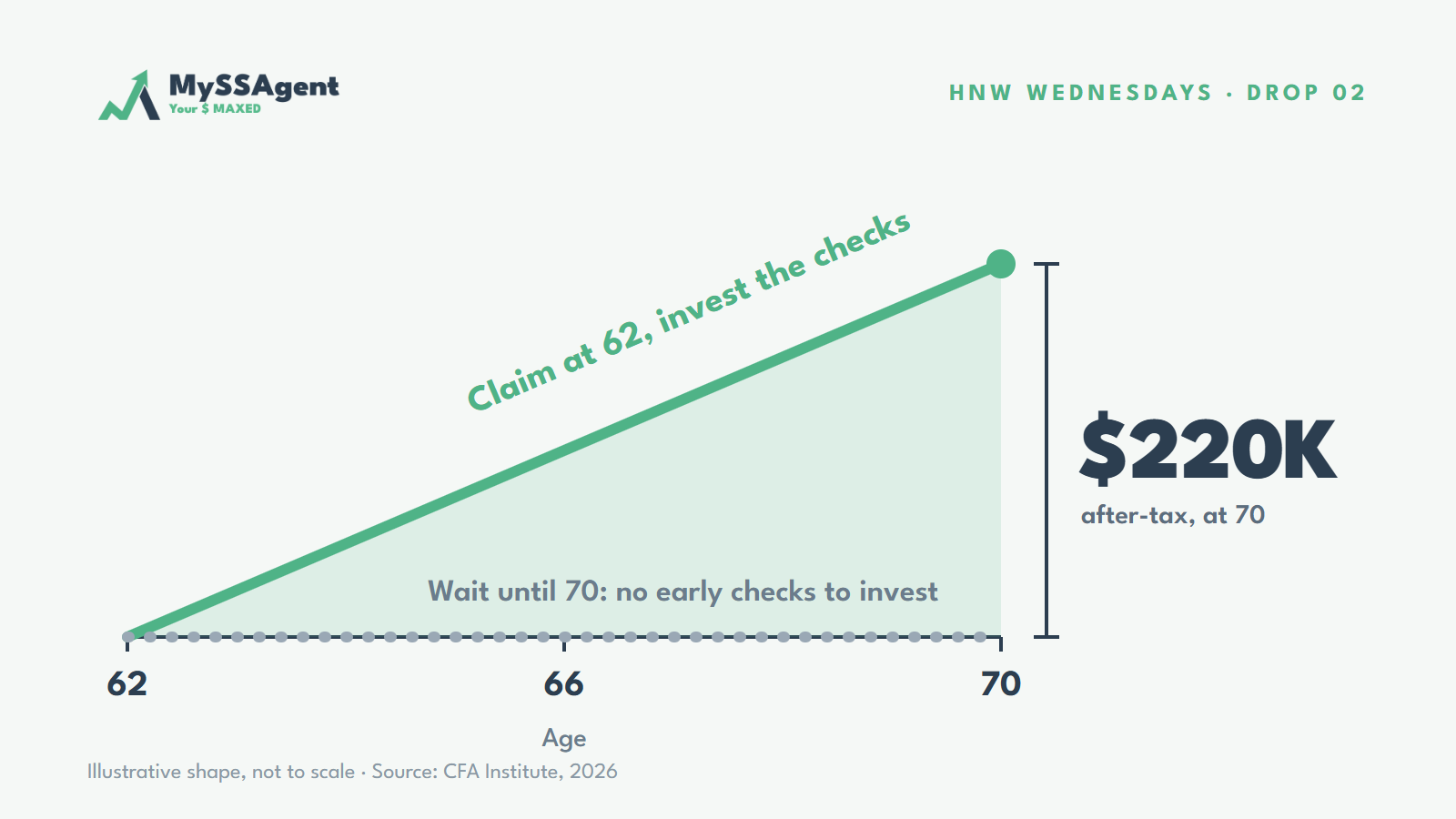
That trade-off doesn't show up in the standard claiming-strategy conversation because the standard conversation only looks at one variable. The check.
For affluent households, the check is the input. The output is what the money does once it lands.
Why the conventional advice misses this
"Delay to 70" is built for a household whose Social Security check is the central retirement-income variable. For most Americans, that's correct. The estimated average lifetime cost of suboptimal claiming runs around $111,000 per household (United Income, 2019) — and most of that loss lands on households where every dollar of monthly benefit matters.
Affluent households are different.
When the early Social Security income is not needed for spending, it doesn't disappear into a checking account. It compounds. Over eight years, with conservative assumptions and realistic taxes, that compounding produces a number that looks a lot like a strong portfolio's annual return rolling forward — because that's what it is.
The advisor who recommends delay without naming the $220,000 is not necessarily wrong. They are incomplete.
There is a difference.
The condition (because this is conditional)
Early claiming is not the new default. We are not advocating affluent clients claim at 62 and call it strategy. The cases where Path B wins on capital can still lose on other dimensions:
Survivor protection. If the higher earner dies first and the surviving spouse will rely on the larger benefit for the rest of their life, delay frequently wins on household terms even when it loses on early-claim capital terms.
Longevity insurance. If the client lives to 95, the bigger lifetime check earns its keep. Path A's larger monthly check keeps paying over a long life.
Tax interactions. Path B layers more taxable Social Security income into earlier years, which can compress Roth conversion windows, push MAGI into IRMAA territory, and complicate withdrawal sequencing. (More on that in the next two drops.)
This is exactly why HNW Social Security planning is a planning conversation, not a filing decision. Both paths can be defensible. Neither is automatic.
The work is in showing the household what each path actually buys — and what it costs.
The advisor takeaway
The better question is not "When should this client claim?"
The better question is: What does this household give up by waiting, and is that trade-off the right one for this plan?
If the answer is delay, that's a recommendation grounded in analysis. The larger check is real. The longevity protection is real. The survivor benefit reinforcement is real.
But if the answer is delay because that's what serious advisors say — the number on the table is bigger than the number on the page.
$220,000 is not a small number to leave unnamed.
The shadow is real. Price it.
Run the comparison the way it should be run. MySSAgent runs the full household comparison — every claiming age from 62 to 70, spousal coordination, survivor protection, break-even, and state tax impact — in 5 minutes or less, applying every relevant rule in the SSA Handbook's 27 chapters. Not generic projections, not folklore.
Advisors: we're opening a founding cohort for firms that want this analysis inside their own practice — early access now. Get founding access →
Professional and Premium analyses include review by a Registered Social Security Analyst® (RSSA®)-credentialed consultant.
RSSA® and Registered Social Security Analyst® are registered trademarks of the National Association of Registered Social Security Analysts, Ltd. (NARSSA). MySSAgent is not affiliated with or endorsed by NARSSA.
Source: CFA Institute, "Social Security Claiming Strategies for High-Net-Worth Clients," 2026.
Related reading
- HNW Wednesdays: Smart Social Security for Affluent HouseholdsThe eight-part series on where default Social Security thinking costs affluent households, and what to do instead.
- Delay to 70 Isn't a Strategy. It's a Default.Drop 01 — the estimated $111,000 average lifetime cost of suboptimal claiming (United Income, 2019) separates default advice from real strategy.
- Your Client's Breakeven Isn't 80. It's 88.Drop 03 — bake in returns, taxes, and real mortality and the standard breakeven moves eight years.
- When “Delay to 70” Breaks: Who Else Is on the Earnings RecordAuxiliary benefits attach to the worker's entitlement, so nobody collects until the worker files — and the family maximum caps the total.
- Claiming Social Security Early for Your Healthiest YearsHealthspan-aware claiming: when front-loading benefits into your healthiest years is the better trade, and when it is not.