Your Client's Breakeven Isn't 80. It's 88.
Run a Social Security breakeven analysis the standard way and a number falls out around age 80.
Claim at 62, claim at 70, draw the lines, find the crossover. Approximately 80. Sometimes 81. The exact number depends on the assumptions, but the answer is always within a couple of years of 80.
That number is wrong.
Or rather — it's right for the question the standard breakeven asks. Which is the wrong question for affluent households.
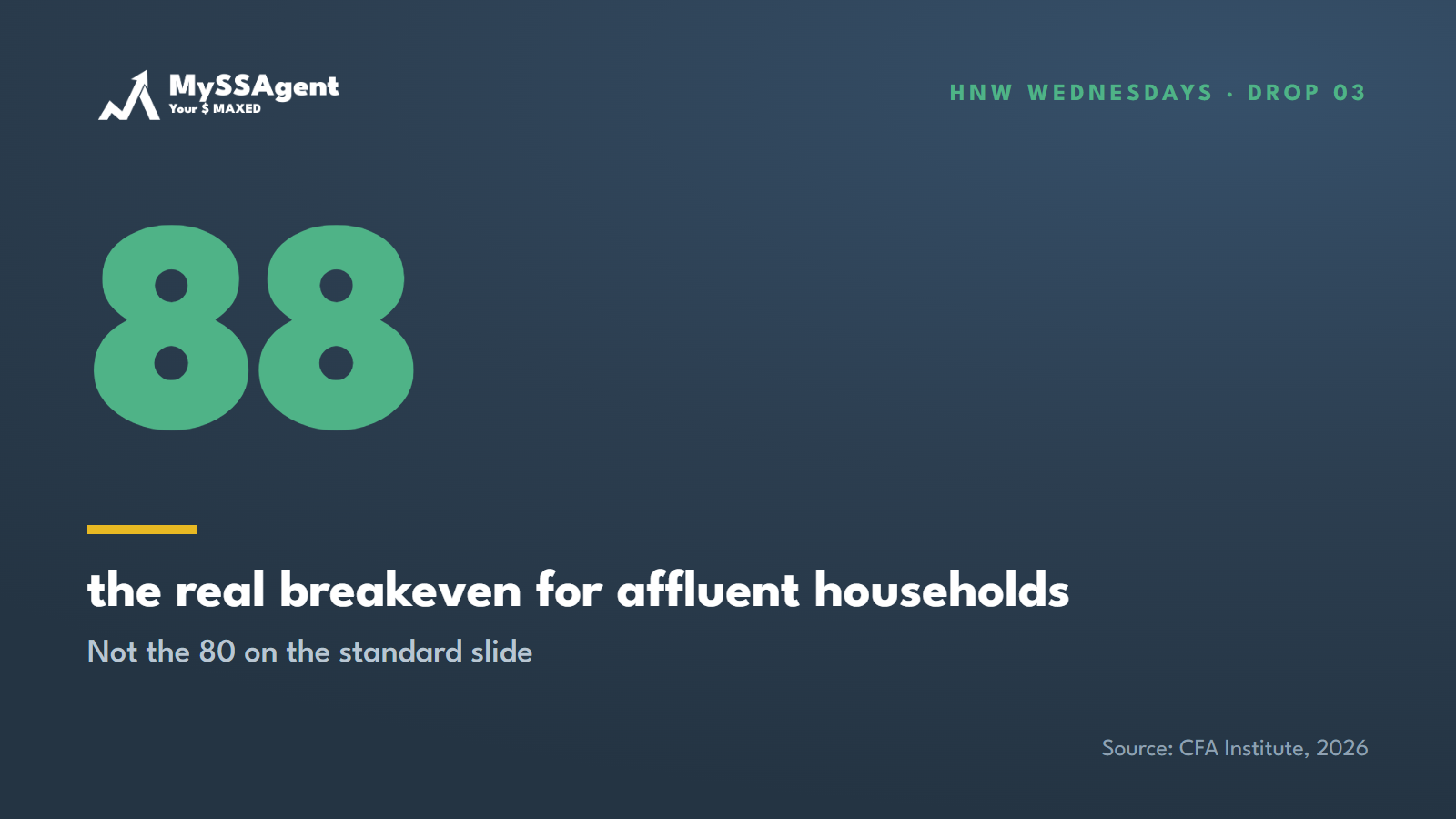
For affluent households, the real breakeven is closer to 88.
88.
A difference of eight years.
Eight years is a long time to be wrong about when a planning recommendation actually pays for itself.
Why the standard number is wrong
The conventional breakeven analysis runs cumulative benefits at one claiming age against cumulative benefits at another. The earlier claimant builds an early lead. The later claimant catches up. The math crosses around 80.
The flaw is in what gets ignored.
Investment returns. Taxes. Realistic mortality probability. Opportunity cost of capital.
When the early Social Security check is invested rather than spent, the early claimant doesn't just build a benefit lead — they build a portfolio lead. By the time the later claimant catches up on cumulative benefits, the early claimant's compounded portfolio is meaningfully larger. To match it on a household-balance-sheet basis, the later claimant has to outlive the early claimant by several years more than the standard math suggests.
Bake in taxes — the early benefit is partially taxable, the invested proceeds generate taxable returns, the later benefit is also partially taxable — and the breakeven shifts further out.
Bake in realistic survival probability for an affluent claimant — life expectancies for higher-income, higher-education cohorts run 3-5 years above population averages — and the timeframe over which breakeven matters changes shape.
Run the comparison for an affluent household with assets, taxes, and realistic mortality, and the crossover lands closer to 88 than 80.
For some households it lands later than 88. For some households it never crosses at all because the early claimant's compounded capital advantage is permanent.
Why this matters more than "the math is technical"
The conventional breakeven number drives a real decision.
When clients hear "breakeven at 80," the implication is clear: if you live past 80, delay wins. If you don't, early claiming wins. That framing is how breakeven analysis gets used in practice — as a heuristic for whether the client "will live long enough."
That framing is wrong for affluent households for two reasons.
First, the household's odds of living past 80 are very high to begin with. Mortality tables for high-income, high-education households put life expectancy in the mid-to-late 80s for healthy 65-year-olds. Life expectancy at 80 is another decade or so. The "live to 80" hurdle is not a hurdle at all for most affluent retirees.
Second, even if the client clears 80, that does not mean delay won the household analysis. It means delay won the simple cumulative-benefits analysis. The household-balance-sheet picture is a different calculation, and it crosses much later.
An advisor citing "breakeven at 80" as the trigger for the delay recommendation is using a number that doesn't apply to the client's actual situation.
The conditional
This is not a recommendation that affluent clients should claim early. The CFA Institute's 2026 modeling — the same modeling that produces the late-80s breakeven — also makes clear that early claiming has real costs in survivor protection and longevity insurance.
If the surviving spouse will rely heavily on the higher earner's benefit, delay wins on household terms even when it loses on early-claim capital terms. If the household values guaranteed inflation-adjusted income above invested capital, delay can still be the right call.
The point is not that the breakeven analysis says claim early.
The point is that the breakeven analysis says claim early-or-late based on a number that is wrong for affluent households by eight years.
The decision should be made against the actual breakeven, not the folklore one.
The better question
"When does this client break even?" is the wrong question to lead with anyway.
The better question is: What would the household's balance sheet, after-tax income, and survivor protection look like under each claiming age, given realistic returns, taxes, and mortality?
That question doesn't produce a single age. It produces a comparison. The comparison is what the affluent client is actually paying for.
Stop selling 80. The breakeven that matters is later. The decision belongs to the household, not the heuristic.
MySSAgent runs the break-even math your clients actually face — every claiming age from 62 to 70, COLA-adjusted lifetime values at multiple lifespans, and state tax impact — in five minutes.
Advisors: we're opening a founding cohort for firms that want this analysis inside their own practice — early access now. Get founding access →
Professional and Premium analyses include review by a Registered Social Security Analyst® (RSSA®)-credentialed consultant.
RSSA® and Registered Social Security Analyst® are registered trademarks of the National Association of Registered Social Security Analysts, Ltd. (NARSSA). MySSAgent is not affiliated with or endorsed by NARSSA.
Source: CFA Institute, "Social Security Claiming Strategies for High-Net-Worth Clients," 2026.
HNW Wednesdays — Drop 03 of 8 · A weekly series from Patrice Ayling for affluent households and the advisors who serve them.
Related reading
- HNW Wednesdays: Smart Social Security for Affluent HouseholdsThe eight-part series on where default Social Security thinking costs affluent households, and what to do instead.
- The $220K Shadow on Every “Wait Until 70” RecommendationDrop 02 — the after-tax capital shadow on delay that nobody prices, and when delay still wins.
- The IRMAA Cliff Your Retirement Plan IgnoresDrop 04 — a two-year lookback and a full-year surcharge make IRMAA a planning variable, not a footnote.
- Claiming Social Security Early for Your Healthiest YearsHealthspan-aware claiming: when front-loading benefits into your healthiest years is the better trade, and when it is not.
- Optimal Social Security Strategy for Married CouplesCoordinate both records — spousal excess, survivor protection, and the claiming-age combinations that maximize the household's lifetime benefit.