The Earned Income Test Is a Tax Surprise, Not a Rule of Thumb
There's a Social Security rule that catches affluent semi-retirees, board members, and consulting-income earners every single year.
Most of them have never heard of it.
Most of their advisors mention it once and move on.
It's the earned income test, and the way it's usually described — "if you work and claim early, you might lose benefits" — undersells how it actually shows up.
The check just doesn't arrive.
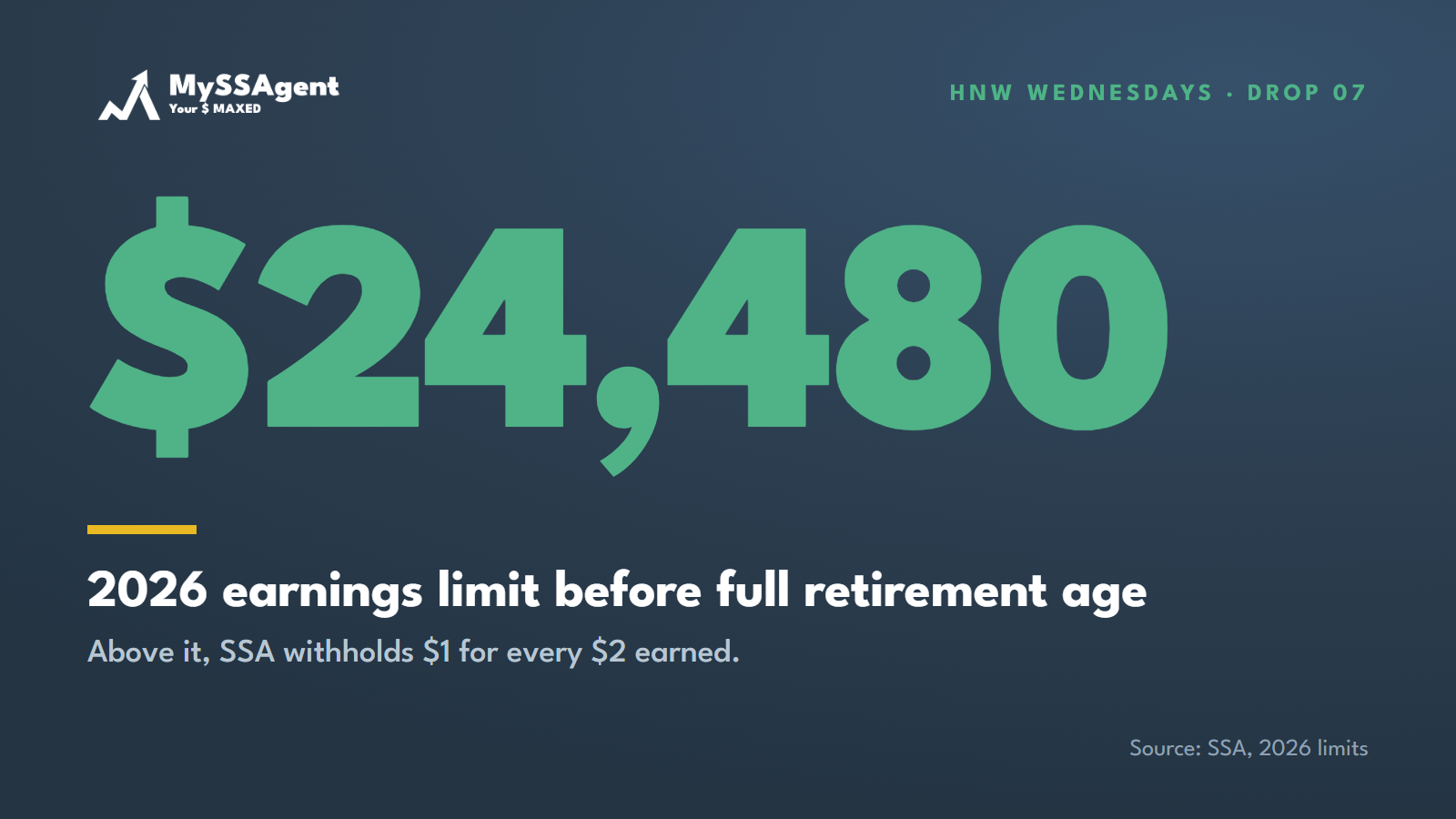
$24,480.
That's the 2026 earnings threshold for someone under full retirement age (FRA) all year. Earn above it, and the SSA withholds $1 in benefits for every $2 over the limit. (For people reaching FRA during the year, a different and much higher limit applies — $65,160 in 2026 — with $1 withheld for every $3 over.)
The mechanic is mechanical. The cash-flow surprise is what catches people.
How the surprise actually lands
The SSA doesn't reduce monthly checks proportionally. It withholds them in whole-month chunks.
Imagine a 64-year-old who claimed Social Security and is receiving $2,200/month. They take a board seat and earn $54,480 — $30,000 over the threshold. The SSA owes them less by $15,000 (half of the excess).
They don't get checks reduced to about $950 each. They get zero checks for roughly seven months and full checks for the rest.
That cash-flow disruption is rarely what the client expected when their advisor mentioned the rule in passing.
Worse, the timing of the withholding is uneven. The SSA reconciles based on actual reported earnings, often after the year is well underway. A consulting client with lumpy income may see benefits stop in summer for income earned in spring.
Who actually gets caught
Three patterns recur in HNW practices.
Semi-retirees. The client who "retired" at 62 and claimed Social Security, then a year later took a part-time consulting role, a board seat, or interim executive work that pays well into six figures. They earn well over the threshold and discover the rule when their checks stop arriving.
Business owners in transition. The owner who sold the company, claimed Social Security at 63 to fund the gap year, then accepted a multi-year earn-out structured as W-2 compensation. Earn-out triggers withholding.
Board members. The retired executive who claimed early, then was invited to serve on three boards. Combined director fees can exceed the threshold without anyone treating the situation as "working."
In all three cases, the client's mental model is "I'm retired." The IRS-reportable earnings are something else.
The good news, and why it matters less than it sounds
Withheld benefits aren't lost. At full retirement age, the SSA recalculates the benefit upward to credit the months that were withheld.
Over a long retirement, the math approaches break-even.
But "approaches break-even at FRA" is not the same as "no problem now." The cash-flow disruption between when benefits are withheld and when the recalculation happens — typically several years — is real. For a household that planned around expected Social Security income to bridge a transition, the disruption can force unexpected portfolio withdrawals at the wrong time.
And in practice, most clients never notice the recalculation when it lands at FRA. The bump in monthly benefit is small relative to the total. The withholding felt like a loss. The recovery feels like an adjustment.
Reasonable people can disagree about whether the recalculation makes the rule benign or just less bad than it looks. What's not debatable is the cash-flow disruption while it's happening.
The planning move
If the client is going to earn meaningful pre-FRA income, the cleaner planning move is usually to delay claiming Social Security until the earnings drop below the threshold or until FRA, whichever comes first.
Once at FRA, the earnings test no longer applies. The client can earn unlimited income and collect full benefits.
This is one of those rules where the right answer is often to let it shape the claiming decision rather than work around it.
If the client has already claimed and discovers they will exceed the threshold, the SSA "first year rule" allows month-by-month application of the limit in the year of initial claiming, which can preserve some checks. After year one, the annual limit applies.
The better question
"Is this client retired?" is the wrong question.
The better question is: What earned income is this client likely to generate in the years between claiming and FRA, and does that income make claiming early structurally incompatible with the household's cash flow?
Most of the time, the answer is to wait until FRA or until earned income drops. Sometimes the answer is to live with the timing pattern. Either way, the decision should be made deliberately, not discovered when the checks stop arriving.
It's not a rule of thumb. It's a tax surprise. Plan around it.
MySSAgent flags earnings-test exposure in the claiming analysis when the household has consulting, board, or transition-period income on the runway. Five minutes. Specific to the client's situation.
Advisors: we're opening a founding cohort for firms that want this analysis inside their own practice — early access now. Get founding access →
Professional and Premium analyses include review by a Registered Social Security Analyst® (RSSA®)-credentialed consultant.
RSSA® and Registered Social Security Analyst® are registered trademarks of the National Association of Registered Social Security Analysts, Ltd. (NARSSA). MySSAgent is not affiliated with or endorsed by NARSSA.
Source: SSA Benefits Planner — Receiving Benefits While Working, 2026 limits.
HNW Wednesdays — Drop 07 of 8 · A weekly series from Patrice Ayling for affluent households and the advisors who serve them.
Related reading
- HNW Wednesdays: Smart Social Security for Affluent HouseholdsThe eight-part series on where default Social Security thinking costs affluent households, and what to do instead.
- Zero Years Are Quietly Shrinking Your Business Owner's BenefitDrop 06 — W-2 wages optimized down create zero years in the 35-year average. Fixable, with lead time.
- Social Security & Medicare 2027: Every Number in One PlaceCOLA, Part B, IRMAA brackets, Part D, earnings-test limits — each figure labeled official or projected, updated in place as agencies announce.
- Business Owner Optimizer: Repair the Zero Years in Your 35-Year AverageSSA averages your highest 35 years of earnings. See what raising a low W-2 salary does to the benefit, with lead time.
- Withdrawal Sequencing, Roth Conversions, and Claiming Are One DecisionDrop 08 — three decisions that all move one variable, MAGI. Plan them together.