The Widow's Gap: A Plan Has to Survive the First Death
A retirement income plan can look very sophisticated while both spouses are alive.
That isn't the hard part.
The harder question is what happens after the first death.
On day one of widowhood, the household drops a Social Security check. The smaller of the couple's two benefits ends. The larger continues. The plan has to absorb the difference.
That mechanic is straightforward. The planning around it usually isn't.
What actually happens
Social Security survivor rules are simple in structure: the surviving spouse receives the higher of either their own benefit or 100% of the deceased spouse's benefit. There is no "both."
The smaller benefit ends.
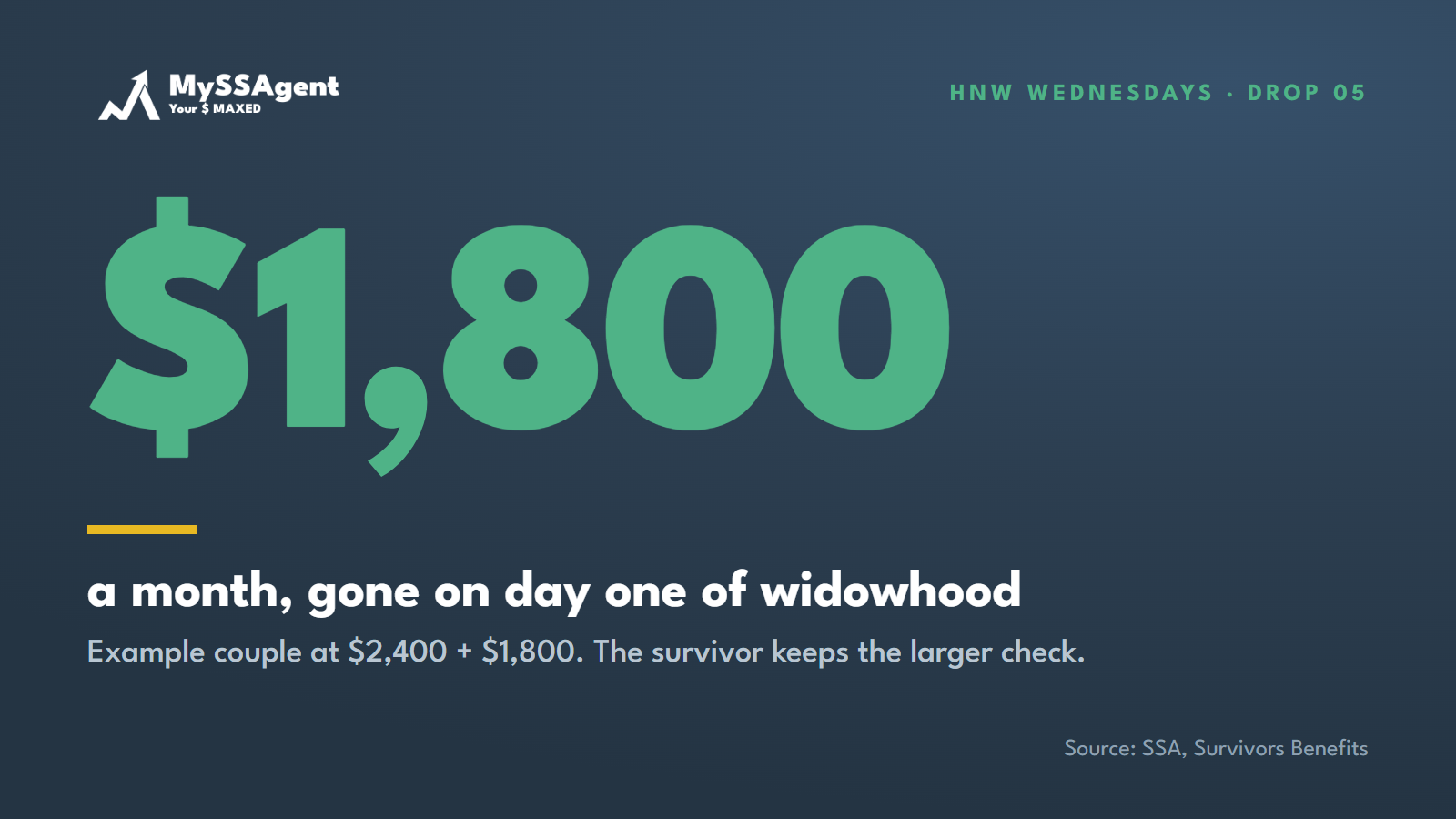
For a couple where one spouse was receiving $2,400/month and the other $1,800/month, the surviving spouse goes from $4,200/month household income to $2,400/month.
$1,800 a month — gone, immediately, on day one.
Annualized, that's $21,600. Over a 15-year widowhood, that adds up to more than $320,000 in lost benefits, before cost-of-living adjustments.
And it lands at the worst possible time. The same household event that drops the check also changes the surviving spouse's tax filing status from married filing jointly to single, which compresses brackets and pulls more retirement income into higher marginal rates. Capital gains, IRA distributions, and even the surviving Social Security benefit may now be taxed less favorably.
Healthcare costs, housing costs, basic living standards rarely halve when the household shrinks to one. Some pressures actually intensify.
Why this gets handled poorly
The conventional Social Security conversation focuses on the couple as a unit. "Maximize lifetime household benefits." "Coordinate spousal claims." "Have the higher earner delay." Those are reasonable planning topics.
They are not the same thing as planning for the survivor.
A strategy that maximizes joint expected lifetime benefits is not always the same strategy that protects the surviving spouse's standard of living. For some households the two answers align — delay by the higher earner reinforces the survivor benefit. For others, they pull apart.
The household that delays purely on "the math" without modeling first death may end up with the higher benefit but a survivor who is still under-protected for housing, healthcare, and tax exposure.
The household that focuses entirely on first-death planning may overweight insurance and underweight the longevity protection that delay actually provides.
The point is not that there is one right answer. The point is that the question deserves to be asked early, explicitly, and with more seriousness than "we'll think about it later."
The survivor questions advisors should be asking
What does the surviving spouse actually live on?
What happens to their tax filing status, and what does that do to bracket exposure?
Does the household have enough guaranteed income outside Social Security to absorb the lost check?
If not, where does the gap get filled — portfolio withdrawals, life insurance, annuity income, downsizing?
Does the surviving spouse have the financial literacy and the operational capacity to manage the plan alone?
These are not exotic questions. They are the basic survivor planning that gets skipped because it is uncomfortable to discuss.
Why this is Jackie Payne's wheelhouse
MySSAgent's RSSA® Credentialed Consultant, Jackie Payne, came to Social Security planning out of three decades in nursing — the last decade of which was patient advocacy work. She spent years across kitchen tables with families managing the financial fallout of serious illness and death. The widow's-gap problem is not a textbook case to her. It is a pattern she watched repeat for years before she started building tools to prevent it.
When Jackie reviews a household's claiming strategy, the first question is rarely "what maximizes lifetime benefits." The first question is what the surviving spouse will live on, and whether the plan still works on day one of widowhood.
Most plans fail that test. Quietly. In ways that don't show up until the test is being graded for real.
The plans that pass it pass it on purpose.
The better question
"How do we maximize this couple's Social Security?" is the wrong opening question.
The better question is: When this couple becomes a household of one, does the plan still work?
If the answer is no, the claiming strategy is incomplete. Not wrong, necessarily. Incomplete.
And incomplete planning has a way of showing up at exactly the moment when no one wants to be doing planning.
If the plan only works while both spouses are alive, it isn't finished.
MySSAgent runs the survivor scenario alongside the joint claiming analysis — modeling first-death cash flow, tax filing status changes, and the household income gap. Reviewed by Jackie Payne, RN, BSN, RSSA®, who built her practice on this problem.
Advisors: we're opening a founding cohort for firms that want this analysis inside their own practice — early access now. Get founding access →
Professional and Premium analyses include review by a Registered Social Security Analyst® (RSSA®)-credentialed consultant.
RSSA® and Registered Social Security Analyst® are registered trademarks of the National Association of Registered Social Security Analysts, Ltd. (NARSSA). MySSAgent is not affiliated with or endorsed by NARSSA.
Source: SSA — Survivors Benefits. Reviewed by Jackie Payne, RN, BSN, RSSA®, 30 years in nursing with a decade of patient advocacy.
HNW Wednesdays — Drop 05 of 8 · A weekly series from Patrice Ayling for affluent households and the advisors who serve them.
Related reading
- HNW Wednesdays: Smart Social Security for Affluent HouseholdsThe eight-part series on where default Social Security thinking costs affluent households, and what to do instead.
- Optimal Social Security Strategy for Married CouplesCoordinate both records — spousal excess, survivor protection, and the claiming-age combinations that maximize the household's lifetime benefit.
- When “Delay to 70” Breaks: Who Else Is on the Earnings RecordAuxiliary benefits attach to the worker's entitlement, so nobody collects until the worker files — and the family maximum caps the total.
- Spousal Benefits Explained: What Couples Need to KnowA plain-English breakdown of how spousal benefits work — the 50% cap, deemed filing, and what delaying does and does not grow.
- Zero Years Are Quietly Shrinking Your Business Owner's BenefitDrop 06 — W-2 wages optimized down create zero years in the 35-year average. Fixable, with lead time.