The retention math behind Social Security advice in an advisory practice
Occasionally I speak with advisors who tell me they don't want to charge for Social Security advice.
I understand this completely. If you're in a position to support your clients on a complimentary, value-added basis and give the claiming decision the time it deserves, that is truly wonderful.
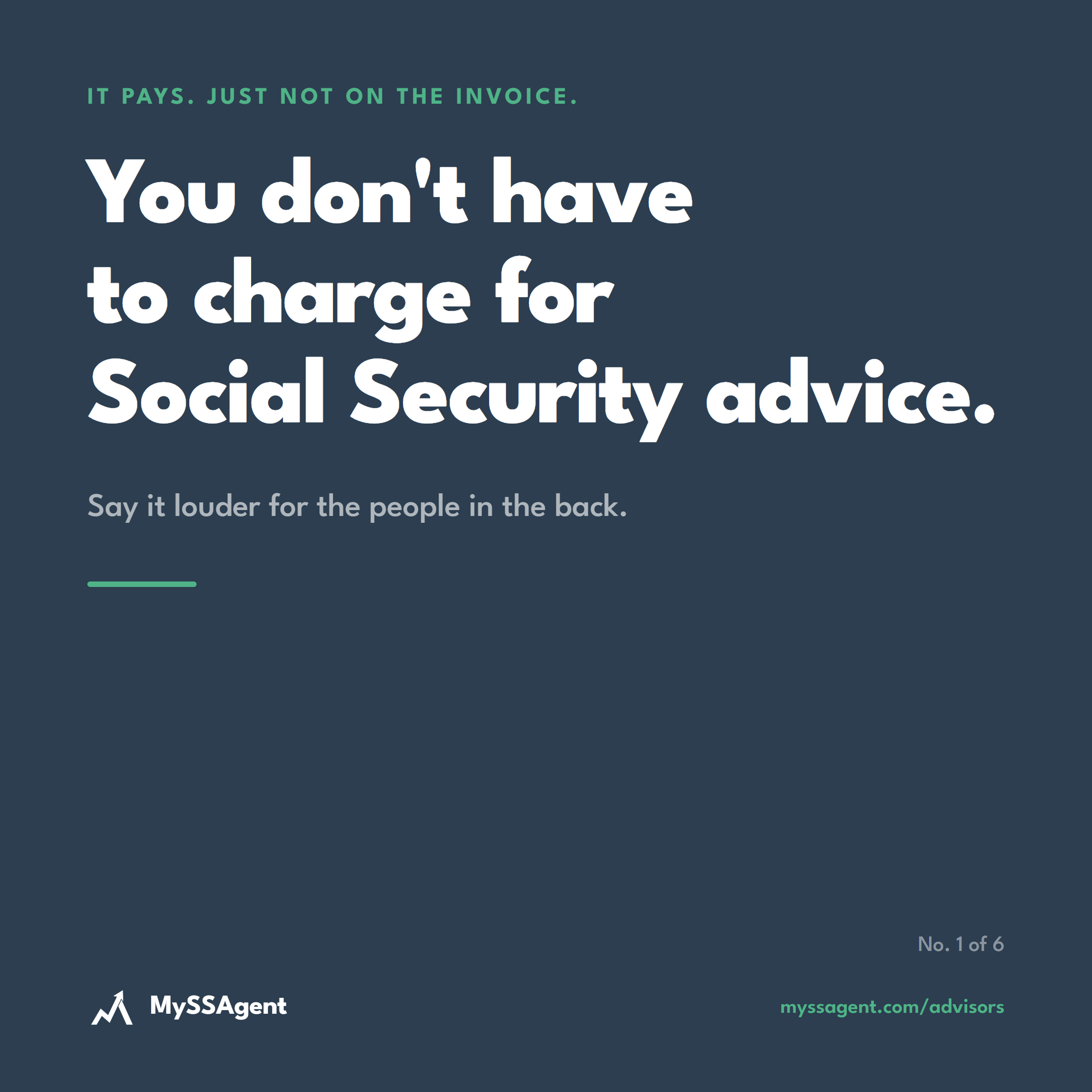
You don't have to charge for Social Security advice.
Say it louder for the people in the back.
I often lead with that, because most people won't take my call or my InMail until they understand what's in it for them. That's perfectly acceptable too. If you're considering adding a Social Security advisory service line, you may not be in a position not to charge. Frankly, when you don't charge, I have a harder time proving the ROI of my software to you.
Here's what the research says about advisors who do choose to offer it as a complimentary, value-added service.
It pays. Just not always on the invoice.
Frederick Reichheld of Bain & Company, the originator of the Net Promoter Score, found that a 5% increase in customer retention increases profits by 25% to 95%. Harvard Business Review has carried that finding since 2014, and it is one of the most replicated results in business research.
It's a cross-industry finding, which is exactly why it matters: it holds everywhere. The services that make clients stay are worth more than the fees you might have charged for them.
In the same piece, HBR puts the cost of acquiring a new customer at five to 25 times the cost of retaining an existing one.
When you offer a current client a high-value service at no charge, you're investing in the cheapest growth a practice has.
YCharts surveyed more than 650 advisory clients in 2019 and asked what they weigh when deciding whether to keep their advisor. 85% said communication style and frequency. Asked whether it factors into referring their advisor to family and friends, nearly nine in ten said yes.
Not performance. Not fees. Communication.
A proactive Social Security conversation is the best communication an advisor ever sends. You raised it before they asked. It's built on their own record. It answers the question every client over 60 is quietly carrying around.
There's a moment in every client relationship where you stop being the person who manages their money and become the person they call first, for everything, personal and professional. The industry calls it trusted-advisor status, and nobody gets there on performance alone. You get there through moments where you gave more than the client expected.
Vanguard's advisor research says it plainly:
"By proactively addressing Social Security in your planning process, you can enhance your value proposition, continue to build trust, and deepen client relationships."
— Vanguard Advisors, February 2026
Social Security is a near-permanent, one-time decision whose consequences compound over decades, and the client only gets to make it once.
The Social Security Administration's own tables are unambiguous. For anyone born in 1960 or later, with a full retirement age of 67, claiming at 62 means a permanent reduction of 30%. For each full year of delay past full retirement age, SSA adds 8% in delayed retirement credits, applied to a larger base that every cost-of-living adjustment then grows on top of, until age 70, when the increase stops.
A United Income (2019) study found only 4% of retirees made the financially optimal claiming decision. Most households are choosing between a smaller check for life and a larger one, without anyone running the numbers on their actual record.
This is the trend that should get every advisor's attention. Urban Institute analysis reported by AARP in August 2025: from January through July 2025, more than 2.3 million people filed for Social Security retirement benefits, up 16 percent from the same period in 2024. Higher-income people, the ones with the most room to delay, were more frequently starting at 62.
Historically, early claiming was far more common: in the 1980s and 1990s, about half of new retirees claimed at 62, per SSA's research on those cohorts. Rates improved for two decades. The 2025 surge put that improvement into reverse, driven by solvency headlines and fear.
The Center for Retirement Research at Boston College puts the cost in one sentence: "ignorance of program rules can mean substantial losses for retirees." One advisor quoted in that piece estimated his clients know about a quarter of what they need to know.
Kiplinger's list of the costliest Social Security mistakes reads like a syllabus: filing early and permanently reducing the benefit; miscalculating full retirement age; leaving delayed retirement credits on the table; overlooking spousal and survivor benefits; never correcting the earnings record; being blindsided by the fact that up to 85% of benefits can be taxable.
Every one of those is a place where a client who feels covered is quietly not.
Here is the most important pair of numbers in this article for advisors.
The Alliance for Lifetime Income's 2024 Protected Retirement Income and Planning study, fielded by LIMRA, surveyed financial professionals and their clients at the same time. It found:
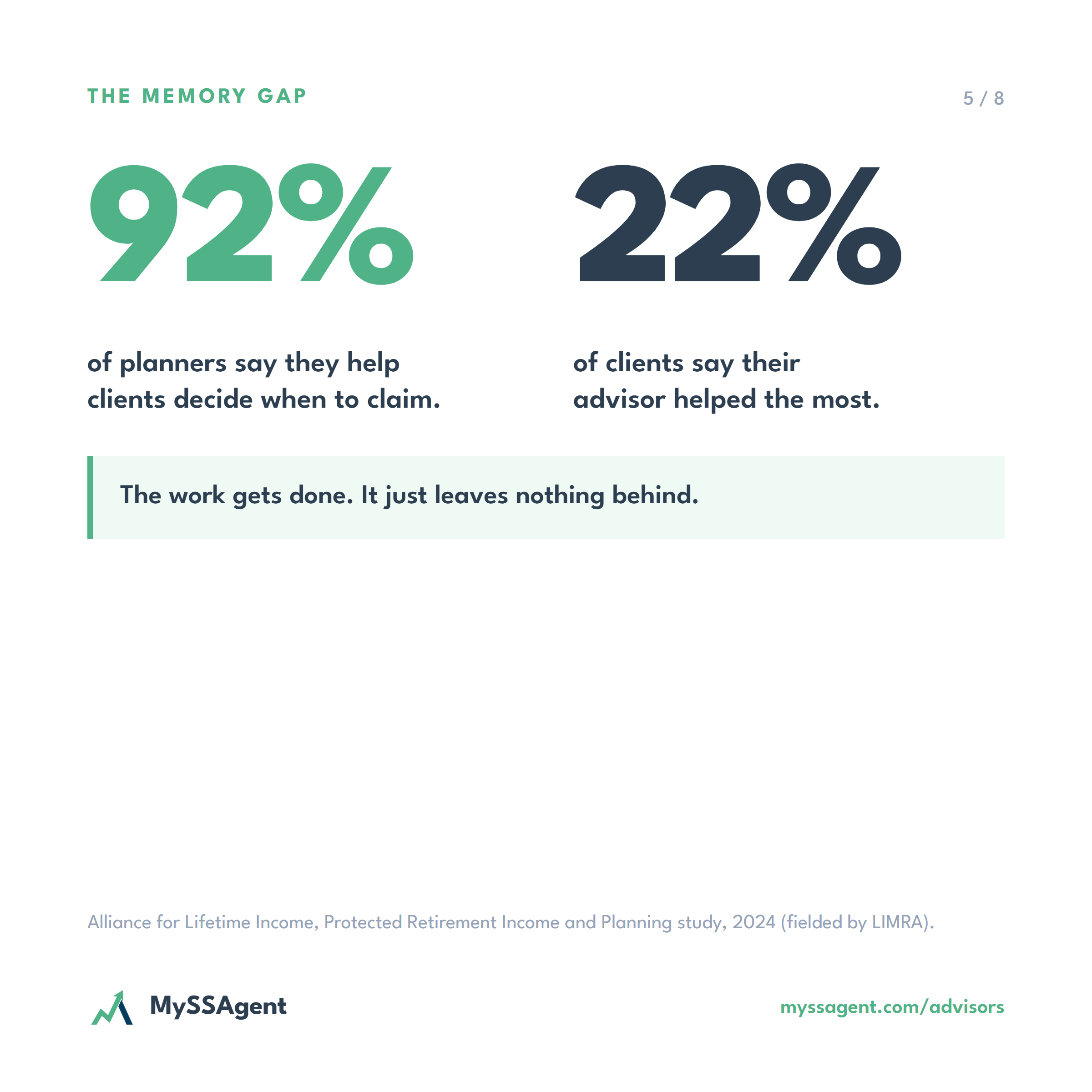
92% of financial professionals say they help clients decide when to claim Social Security.
22% of clients say their financial professional helped the most when they decided to start claiming.
The same study, on the wider conversation: 98% of professionals say they discuss protected-income sources such as Social Security, pensions and annuities. 69% of clients agree.
Read that carefully, because it isn't a competence gap. The work is getting done; 92% of planners aren't wrong. It's a memory gap. The claiming conversation happened inside a planning meeting, out loud, next to nine other topics, and it left nothing behind. So when the client thinks back on who got that decision right, nobody comes to mind.
So the fix is to make what you already do visible: a printed analysis with the client's name on it, every filing month from 62 to 70, the recommended date with the dollars beside it. Something that goes in a drawer and comes back out when a brother-in-law asks.
That's the difference between "we discussed it" and "my advisor handled that."
Whether you charge for Social Security advice or offer it as a complimentary, value-added service, the business case is the same:
| Action | Impact |
|---|---|
| Proactive, value-added service | Builds trusted-advisor status |
| Trusted-advisor status | Drives retention and referrals |
| Retention | Lifts profit 25% to 95% on a 5% improvement (Reichheld / Bain, via HBR) |
| Referrals | Sidestep a client-acquisition cost that runs 5 to 25 times retention (HBR) |
| A documented claiming analysis | Closes the 92% to 22% gap between what's done and what's remembered (ALI / LIMRA, 2024) |
The ROI of a complimentary service often lives outside the fee schedule: in a ten-year relationship, a referral at a dinner party, and a client who says, "My advisor handled everything."
Whether your clients get that support from you or from someone else, this high-stakes, one-time, near-permanent decision deserves a thorough look.
That's something we can all agree on.
Sources
This article is educational and is not tax, legal, insurance or compliance advice.