For Medicare brokers & retirement-income advisors
On July 28, 2026, CMS released preliminary technical Part D bid information for contract year 2027 — and, in the same release, announced that the Part D Premium Stabilization Demonstration is ending.
| Measure | 2027 | What it is |
|---|---|---|
| National average monthly bid amount (NAMBA) | $296.05 | Enrollment-weighted average of plan bids for the basic benefit. Used to calculate the government subsidy to plans — not a premium anyone pays. |
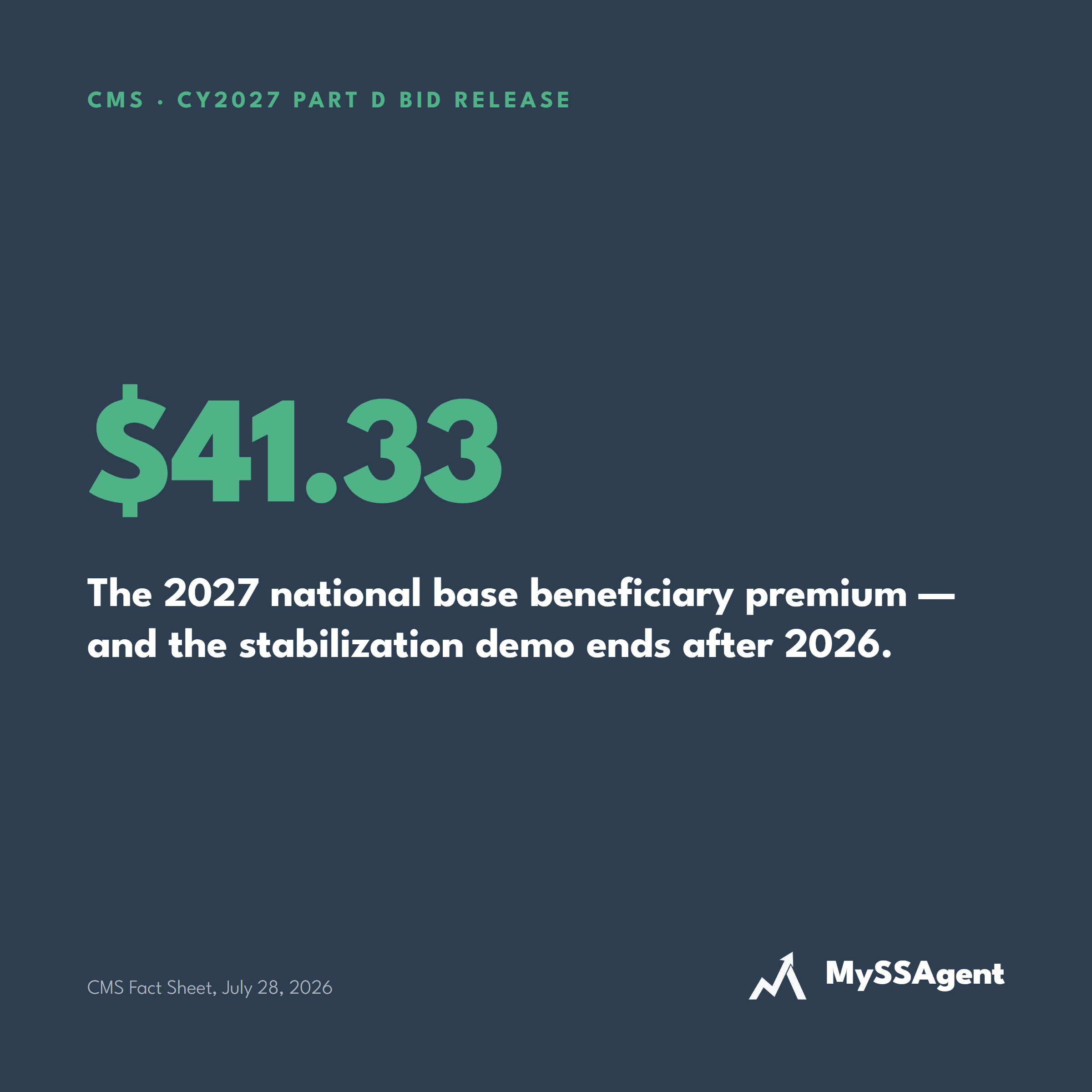
| National base beneficiary premium | $41.33 | The starting point for calculating each plan's basic Part D premium. |
| IRA cap on the base premium increase | 6% / yr | Applies between 2024 and 2029 under the Inflation Reduction Act's premium stabilization provision. |
Two distinctions are worth holding onto, because they get blurred in coverage. The NAMBA is a subsidy input, not a consumer price. The base beneficiary premium is also a starting point for a plan-specific calculation, not the premium a given client will be billed.
The headline is not the bid figure. It is this: CMS is discontinuing the Part D Premium Stabilization Demonstration at the end of CY 2026, "to return the program to operating under traditional market conditions in CY 2027."
That demonstration was a voluntary program for standalone prescription drug plans, stood up in CY 2025 to address volatility and variation in standalone premiums after the Inflation Reduction Act's benefit redesign. CMS's stated reasoning for ending it is that bid analysis indicates plan sponsors now have sufficient experience under the redesigned benefit to support their pricing assumptions.
What that means in practice: the base beneficiary premium remains capped at a 6% annual rise through 2029. What is not capped is how individual standalone plans price themselves once the stabilization program is gone — and plan-level movement is what a client sees in the mail.
CMS publishes the 2027 Medicare Advantage (MA) and Part D landscape in mid-to-late September, once offerings are finalized. That is the window between knowing this is coming and having the conversation.
A premium increase lands on a fixed income. The instinct is to solve it inside the drug plan — shop the formulary, compare the tiers, move the client. That work matters, and it has a ceiling.
The larger lever on a retiree's income is when they claim Social Security, and for any client who has not yet filed, it is still open. Claiming timing sets a monthly amount for life, adjusts with the annual cost-of-living adjustment (COLA) on top of that base, and determines the survivor's floor after the first death.
It also feeds back into Medicare directly. Up to 85% of Social Security benefits are taxable and count toward the modified adjusted gross income that sets IRMAA — and IRMAA runs on a two-year lookback, so income this year shows up in Medicare premiums two years out. We cover that interaction in detail in Social Security claiming timing and the IRMAA lookback.
Not for lack of interest. The math is genuinely difficult: two earnings records for a couple, every possible filing month between 62 and 70, spousal and survivor interactions layered on top, and a family maximum that is a bracketed formula rather than a flat percentage. It is not a legal-pad calculation between appointments.
That difficulty is exactly why it stays unclaimed — and why an agent who can answer it holds a conversation nobody else in the client's life is having.
A premium increase is a call you absorb. A claiming decision is work you can be paid for. MySSAgent runs your client's own earnings record and returns the optimal claiming age with the dollars attached, so the autumn call stops being damage control and becomes the reason they stay with you. Every client in the window, about a minute each. No Social Security number is ever entered.
See how it works for brokers →Sources
This article is educational and is not tax, legal, insurance or compliance advice. Plan-specific premiums, IRMAA determinations and eligibility depend on individual circumstances.