For financial advisors & insurance professionals
Clients are asking what happens if Social Security gets cut. Most of us answer with reassurance. There is a better answer, and it has a number attached — provided the number is presented honestly.
Two depletion dates circulate in coverage, and advisors get caught out because both are correct — for different funds.
| Fund | Reaches the point | Then payable from continuing income |
|---|---|---|
| OASI alone (retirement & survivors) | Q4 2032 | ~78% |
| OASI + DI combined (hypothetical) | Q3 2034 | ~83% |
Per the 2026 Trustees Report. The combined figure is explicitly a hypothetical — the two funds are legally separate, and combining them would take legislation. If a client brings you a headline citing one date and an analysis citing the other, neither is wrong; they are describing different things.
Practical rule: never state a depletion date without naming the fund. It is the fastest way to look imprecise in front of a client who has read a different article.
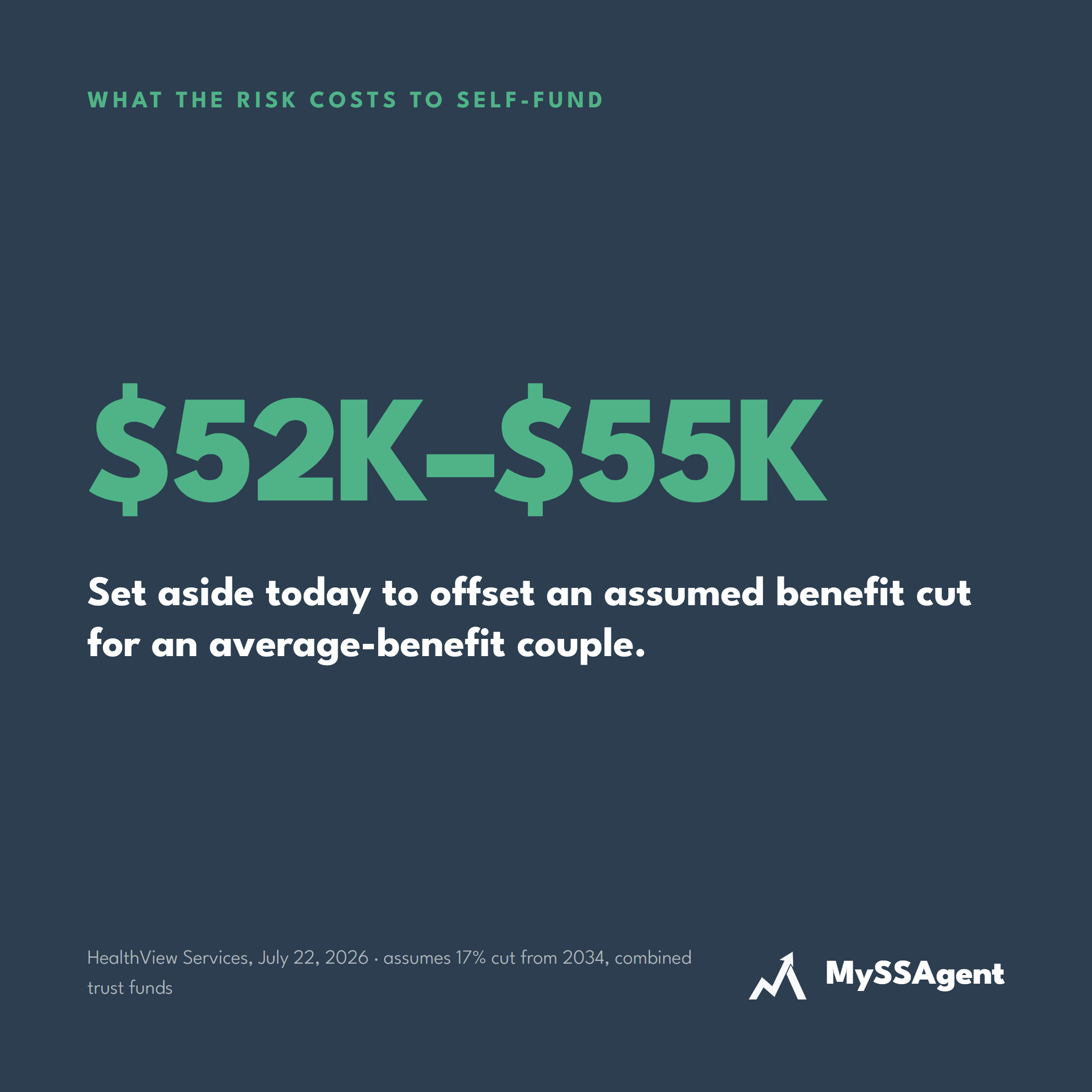
In July 2026, HealthView Services published an analysis putting dollar figures on the exposure. Their assumption — and it is theirs, stated here so it can be judged — is a 17% reduction beginning in 2034, treating the retirement and disability trust funds as combined.
| Couple, age 54, retiring in ~8 years | Estimated lifetime loss | Set aside today to offset |
|---|---|---|
| Average benefits | $161,000 – $194,000 | $52,000 – $55,000 |
| Maximum benefits | $425,000 – $509,000 | $123,000 – $130,000 |
The offset figures assume a 6% rate of return. These are estimates produced by a third party under its own assumptions, not projections by SSA and not our numbers.
The loss figure produces alarm. The set-aside figure produces a conversation, because it converts an abstract policy worry into something a client can weigh: this is what it would cost to simply neutralize this with money.
For most households the answer is that they do not have a spare $52,000 for this. The ones who do would generally rather not park it against an outcome nobody controls.
There is another way to move the same lifetime benefit total, and it does not require new money: when the client claims.
Claim timing changes lifetime benefits substantially on its own. It sets the monthly amount for life, determines the base that every future cost-of-living adjustment (COLA) is applied to, and — for a married couple — sets the survivor's floor after the first death.
Say this precisely, because the temptation is to overstate it. A savings set-aside and a claiming decision are not the same dollars. One is a savings target against an assumed legislative change; the other is a timing decision within existing law. They happen to move the same number. Optimizing a claiming date does not recover, offset, or insure against a benefit cut, and presenting it that way is an overclaim.
What is fair to say is this: a household facing an uncertain future benefit has one large decision still fully within its control, and most households make it without calculating it.
For a couple: two earnings records, every filing month between 62 and 70 for each of them, spousal and survivor interactions, and the effect of each combination on the household's lifetime total. That is not a rule-of-thumb exercise, and it is not something an advisor should be doing by hand in a meeting.
Related reading: when "delay to 70" breaks, and how claiming feeds into Medicare's IRMAA surcharge.
The households asking this question are the same ones deciding whether to consolidate advisors. MySSAgent gives you the second number — what the timing decision itself moves, computed from their own earnings record — so your answer is arithmetic instead of reassurance. Every household in the claiming window, not only the one who asked. No Social Security number is ever entered.
See how it works for advisors →Sources
This article is educational and is not tax, legal, insurance or investment advice. Third-party estimates are attributed to their source and reflect that source's assumptions. Future benefit levels depend on legislation that has not been enacted.