The Uncapped Broker · For Medicare brokers
Your AEP calendar is about to fill up. Every appointment on it pays a commission, and your commissions are capped.
Here is a number nobody capped.
When a client’s modified adjusted gross income crosses $109,000 filing single or $218,000 filing jointly, their Part B premium steps up, and it keeps stepping through the brackets above that. Those are the 2026 lines. CMS puts it at roughly 8 percent of people with Part B. You have seen it land on a client’s statement, and you have had the awkward call about where it came from.
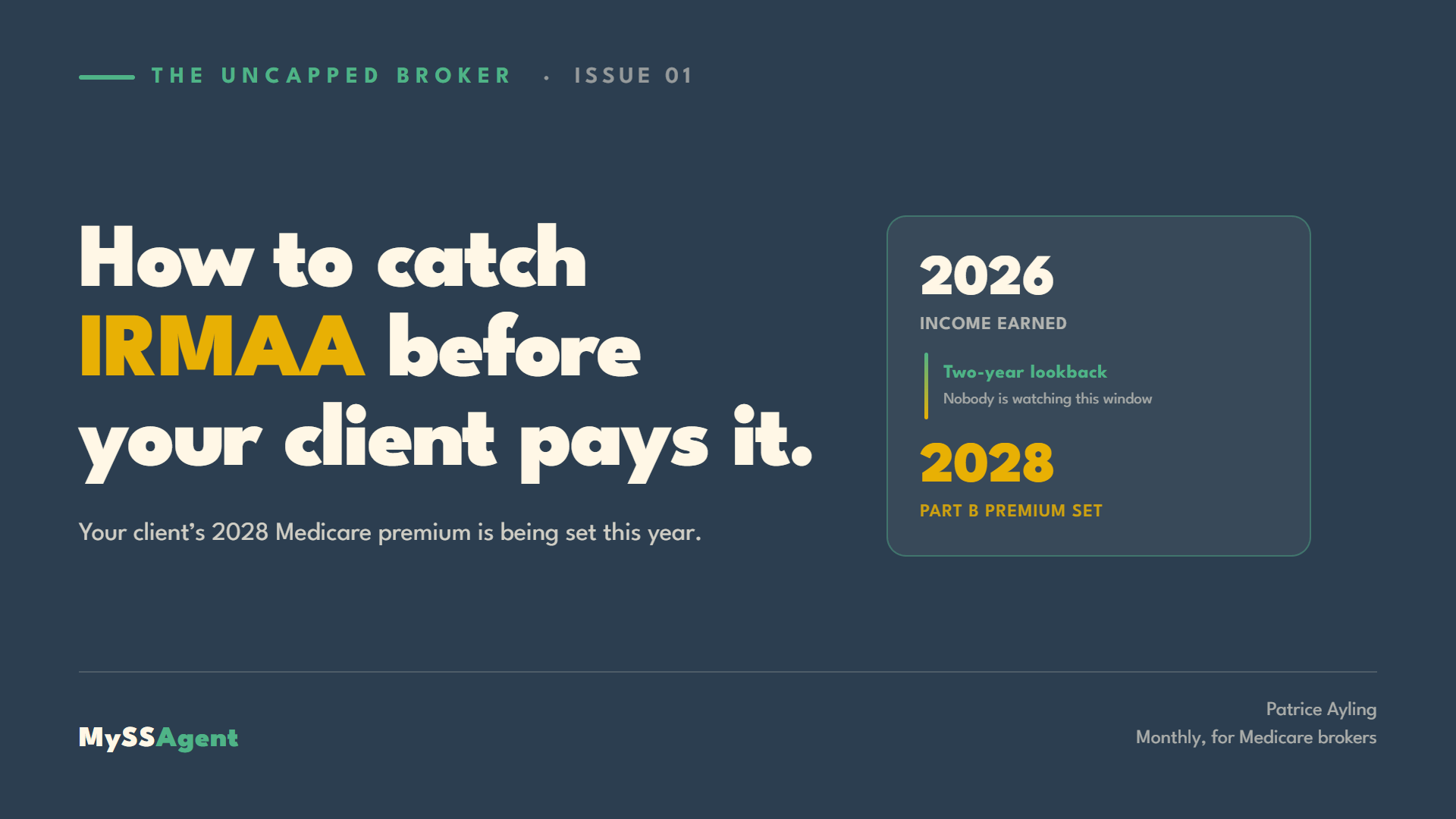
The timing is the whole story. IRMAA runs on a two-year lookback. The Part B premium your clients pay this year was set by the tax return they filed for 2024. The income they earn this year sets their premium in 2028.
So the surcharge shows up as a billing problem. It is really a planning problem, and planning problems can be caught early.
The first one is this year’s surcharge.
Social Security keeps a form for it. SSA-44 lets a client ask to have the surcharge recalculated on what they earn now, after one of eight life-changing events defined in 20 CFR § 418.1205. Two of the eight are retirement in government language: work stoppage and work reduction.
Picture the most common client in your book. They worked a full year in 2024, retired in 2025, and turned 65 this year. Their premium is based on a salary they no longer earn. SSA wants proof of the event, usually a letter from the employer. Knowing that before you raise it is the difference between an interesting comment and a problem solved.
Death of a spouse is on the list too. Filing status moves from joint to single, the threshold drops with it, and the recalculation is available in the worst month of someone’s life.
The second one is the premium two years out.
When a client turns on Social Security changes their taxable income. Up to 85 percent of a benefit can count on thresholds Congress set in 1983 and 1993 and has never indexed. A claiming decision made this year can push a household over an IRMAA line in 2028, long after anyone remembers making it.
Nobody in that client’s life is watching for this. Their accountant worked last year. Their advisor watches the portfolio. You are the one talking about Medicare premiums, so you are the one positioned to catch it.
A single claiming analysis bills at published advisory rates, depending on how complex the case is.
You do not have to become a Social Security analyst to do this work. You need to see where the line is, see how much room a household has below it, and know when to bring in an expert.
Charge for it, or fold it into what your clients already get from you as a reason to stay. Either way, you are the one who saw it coming.
We walked through all of this live on September 23, in How to catch IRMAA before your client pays it. The replay covers:
That is what this newsletter is for. Once a month, how to turn Social Security claiming advice into awareness, income and client retention. Tips for maintaining or monetizing your book that are not capped.
The next issue picks up the years before Medicare: Sixty-two comes before sixty-five.
Thank you for following along,
Patrice Ayling
Sources
Educational material, not tax or legal advice.