The Uncapped Broker · For Medicare brokers
Medicare’s annual enrollment period (AEP) is open. Marketplace open enrollment starts November 1. Once it opens, two segments of your book, T65s and current or near-retirees, are in enrollment at the same time.
On the under-65 side, you will sit with clients in their late fifties and early sixties and talk about premiums, subsidies and income.
You probably think of that under-65 book as your Medicare pipeline, and it is. Every client in it who is 60 to 64 today is an enrollment you expect to write in the next five years.
Last month I promised this issue would look at the years between retiring and claiming. For many of the clients on your under-65 book, those are the years they are in right now. Some retired early because they could. Others were downsized or lost their employer coverage.
Here is what happens before you get there.
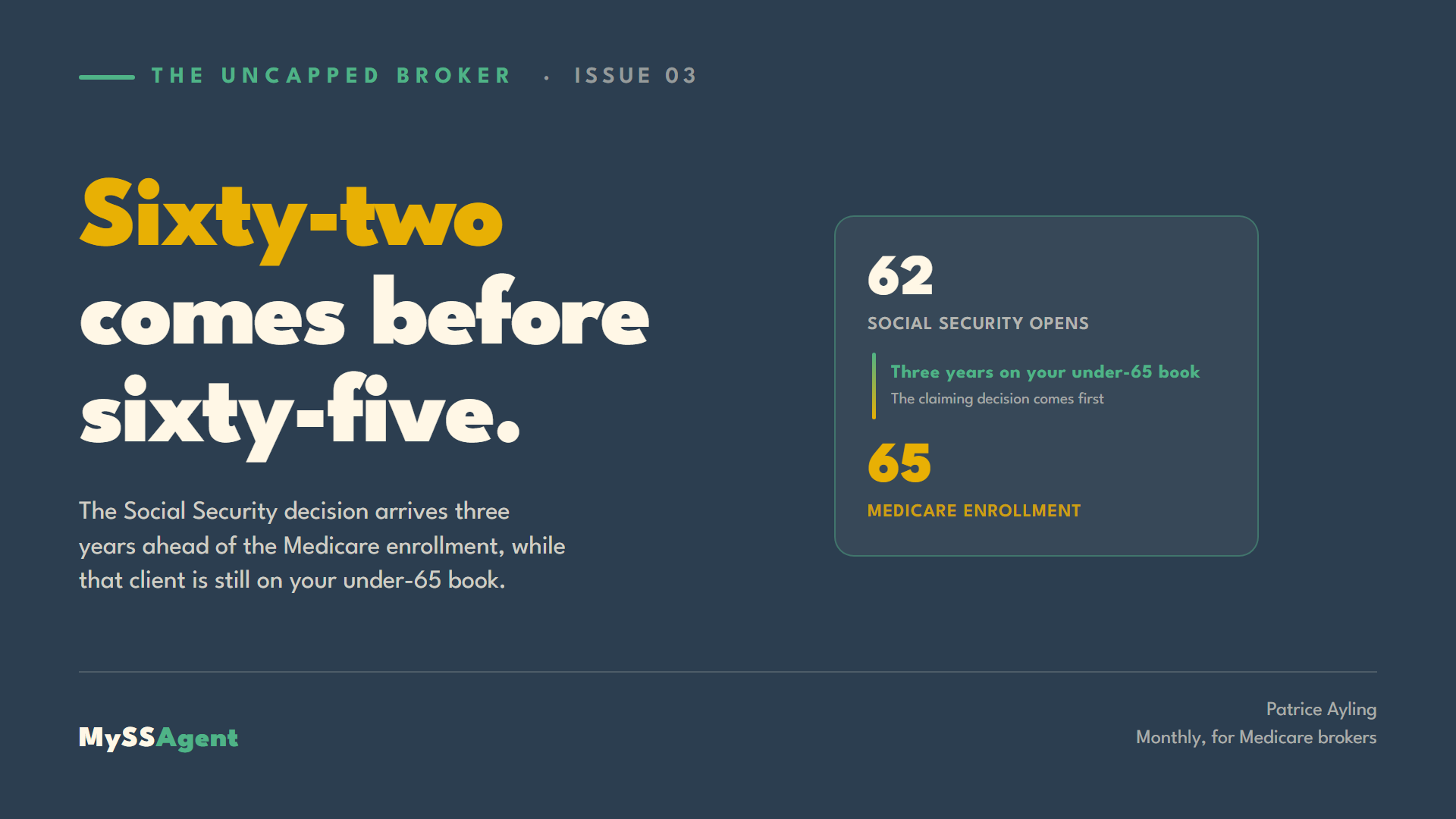
Social Security opens at 62. Medicare opens at 65. The claiming decision arrives three years ahead of the enrollment, while that client is still on your under-65 book.
Plenty of them take it. Roughly one in five new retirement benefits starts at 62, the earliest age allowed. About half of all new awards start early enough to carry a permanent reduction.
By the time that client becomes a Medicare enrollment, the biggest income decision of their retirement is often already made, and nobody modeled it with them.
An independent Medicare broker in New England walked through the analysis with us recently. Partway through, she stopped on her own book:
“I could see advertising this to our ACA side book of business.”
Her reason was the clients themselves: “they just haven’t looked at it. They haven’t really thought about it.”
She said it without judgment, and the data agrees with her. In Nationwide’s 2025 Social Security survey, only 21 percent of adults could correctly name their own full retirement age.
Marketplace subsidies are scored on income. For that calculation, all of a client’s Social Security counts, including the part the IRS never taxes. A 62-year-old on a marketplace plan who turns on a benefit adds the whole check to the number their subsidy is measured on.
Under current law the premium tax credit stops completely above 400 percent of the federal poverty line. There is no taper.
So the month a client claims can change what they pay for coverage every year until 65. Then the same decision follows them into Medicare, because IRMAA reads the tax return from two years back. The return that sets their first Medicare premium is the one they file for the year they turn 63.
One decision, and it touches both of your books.
To be clear about lanes: MySSAgent does not price a subsidy or place anyone in a bracket. That stays with you and their tax professional. What it settles is the other end of the same question: what each claiming month from 62 to 70 is worth to that household, in dollars.
A single claiming analysis bills at published advisory rates, depending on how complex the case is. That is the going rate for the work.
The broker I quoted did the arithmetic while we talked: a software license divided across the households it covers, set beside what she could charge. Then she said why she can bill for it at all: “because it’s not Medicare related, so we can charge for… that work.”
It is a separate service, in a separate appointment, for a client who already trusts you. You start earning from that relationship at 62.
A client who did this work with you at 62 arrives at 65 already knowing how you work. Their my Social Security account is set up, because the analysis needed it. Their claiming plan is on file. The Medicare conversation starts from a plan.
You know what their mailbox looks like that year. You will already be the person they call.
Some of these cases are not simple. A 62-year-old who is still working runs into the earnings test, and a couple brings two records and a survivor question. You do not have to become the expert. When a case gets complicated you can phone a friend: a credentialed Registered Social Security Analyst® works it with you.
During open enrollment you will see most of your 60-to-64 clients anyway. One question opens it:
“Have you looked at your Social Security statement lately?”
Most will say no. You may be the first person who has asked.
That is what this newsletter is for. Once a month, how to turn Social Security claiming advice into awareness, income and client retention.
Patrice Ayling
Sources
Educational material, not tax or legal advice.