For independent advisors
A post on r/CFP this month made the case for going solo in four lines. Launch a firm for about $5,000. Run it on $15,000 to $20,000 a year. Serve 40 to 60 families. Let AI do repetitive work. Then it asked why more advisors aren’t doing it.
More than a hundred replies later, most people agreed with the economics. Then thread after thread landed in the same place: finding those 40 to 60 families is the hard part. The original poster conceded it too. Their setup covered compliance, custody and technology, they wrote, but not client acquisition.
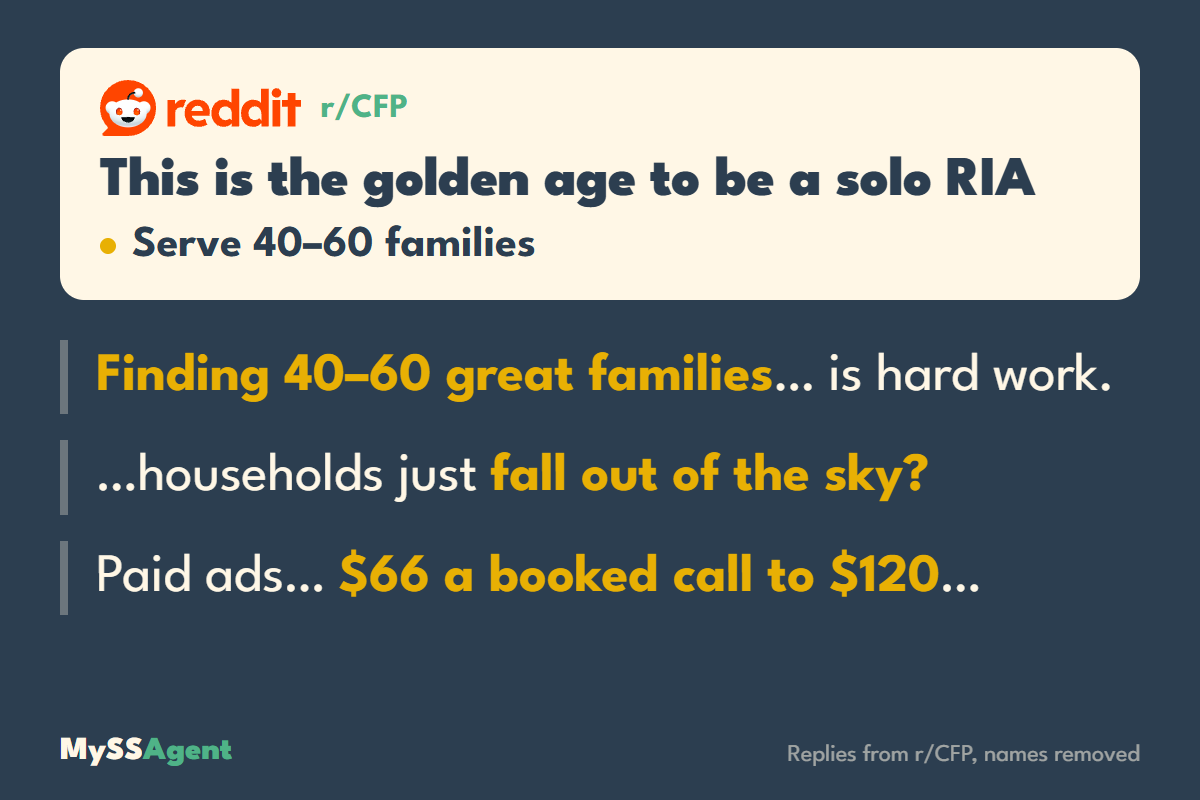
Michael Kitces called this the coming golden age of the solo advisor back in 2018, and the cost side has only improved since. What’s left is the question the thread kept asking. Where do the families come from?
Most people don’t wake up wanting a financial plan. They wake up with a specific problem that has a date attached.
The advisors in that thread who had built a book kept describing the same move. Get known for answering one concrete question well, and let the planning conversation follow. One solo planner on the same forum said tax prep was far easier to market than planning, so tax became the front door to the whole practice.
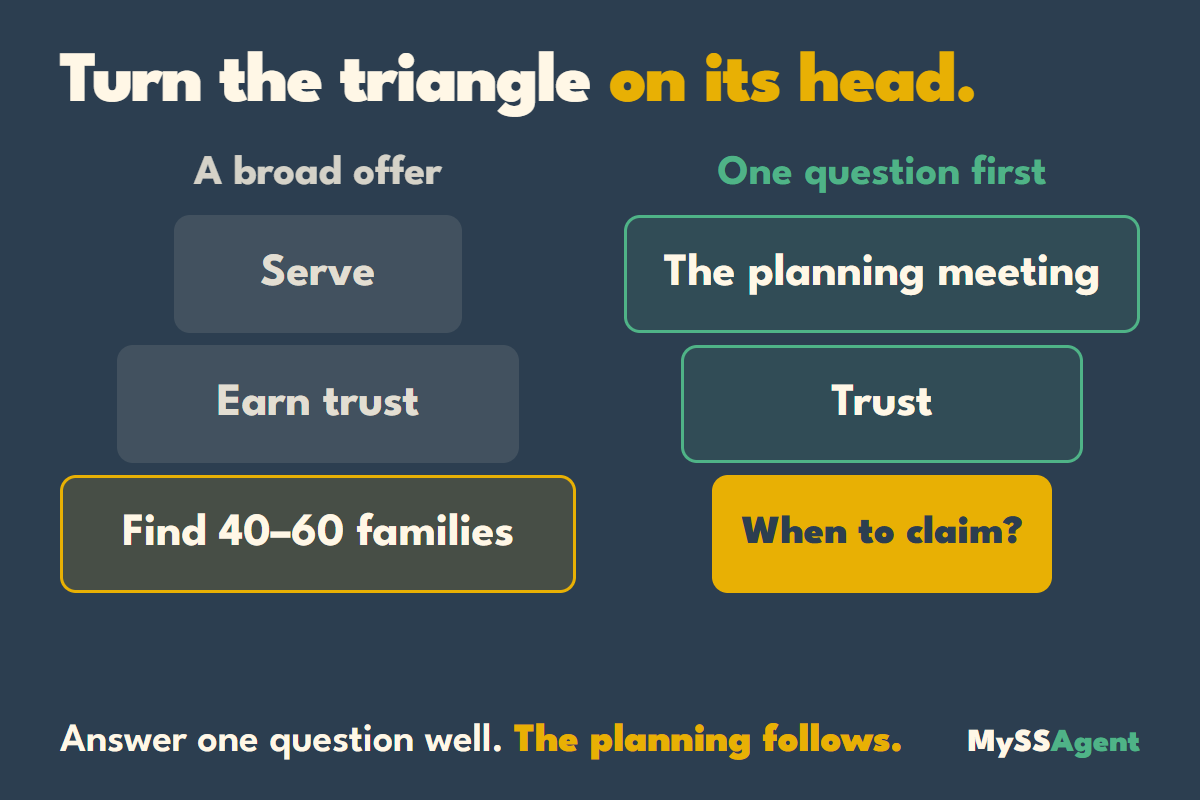
Paid acquisition works on the same principle. One advisor in the thread said ads were the only thing that had worked for them, at roughly $66 to $120 per booked call. Whatever you spend to get a call, a specific offer is easier to say yes to than a general one.
It runs on a deadline. Benefits can start at 62. Full retirement age is 67 for anyone born in 1960 or later. Delayed retirement credits stop at 70. People arrive at this question on their own schedule, whether or not anyone is marketing to them.
The answer is in dollars. Each claiming month from 62 to 70 pays a different monthly amount for life, and the higher earner’s choice carries over to a surviving spouse. You can show someone the gap between two ages, in their own numbers, in the first meeting. Sometimes the right answer is to claim early. Either way, it’s their number.
It’s a household decision. A married couple’s plan involves two earnings records and the survivor benefit, so both spouses come to the meeting.
It reaches people at the right moment. Someone deciding when to claim is in their late 50s or 60s, when rollovers, income plans and the first years of retirement are all on the table.
Here’s a quick way to test it. Use your own fee and minimum in place of these.
One household, one year
Illustrative, on one scale. Swap in your own fee and minimum.
One household that comes in through the claiming door covers a year of the license ($1,990) about twice over, before the second year’s fee. The numbers above are illustrative. The shape holds for most fee schedules: the review is cheap, and the relationship is not.
MySSAgent models every claiming month from 62 to 70 against the client’s Social Security earnings record and produces a report you can walk through together. The Professional license is $1,990 a year for 25 household analyses. A married couple counts as one household, and re-runs for that household are free.
The math on going solo works. Filling the calendar is the part you build. One question gets you there.
Advisor plans start at 25 households for $1,990 a year: see advisor pricing.
See how it works for independent advisors →Sources
Educational material, not tax or legal advice.